


The Guide to the Vanuatu Language: Bislama
Vanuatu might hold the world record for the highest density of languages on the planet. Don't worry, you won't have to learn them all when visiting. This small island nation is home to around 138 indigenous languages spoken by just over 300,000 people, plus three official languages, Bislama, English and French, making over 140 languages in total.
While English and French will certainly help you get by during your travels, Bislama is the national language that connects locals across all the islands.
You're bound to encounter plenty of Bislama words and phrases during your getaway. Locals will say goodbye with a warm "lukem yu", you'll visit "kastom" villages, and you might even enjoy a kava at a "nakamal".
Ready to dive into this fascinating language? Let's explore the basics of Bislama in this quick guide to the language of Vanuatu.
This article is based on real on-the-ground research, not on AI scraping old content from the internet. Learn how we use AI!
Table of Contents
6 Fun Facts About the Vanuatu Languages
- Vanuatu used to be home to around 500 dialects; now there are around 138 local dialects.
- Most people in Vanuatu speak at least three different languages: their local dialect, Bislama and either French or English.
- Bislama developed as a way for people from different islands and language groups to communicate.
- Many Bislama words come from English, but the grammar and pronunciation are uniquely Melanesian. For example, “How are you?” becomes “Yu oraet?” which you will hear everywhere from markets to buses.
- Bislama uses small words in clever ways. The word “blong” means belonging to, of, from, or about, depending on context. “House blong mi” simply means “my house”.
- Bislama is famously easy to pick up for native English speakers, even if you are only visiting for a short time.
Where Does Bislama Come From?
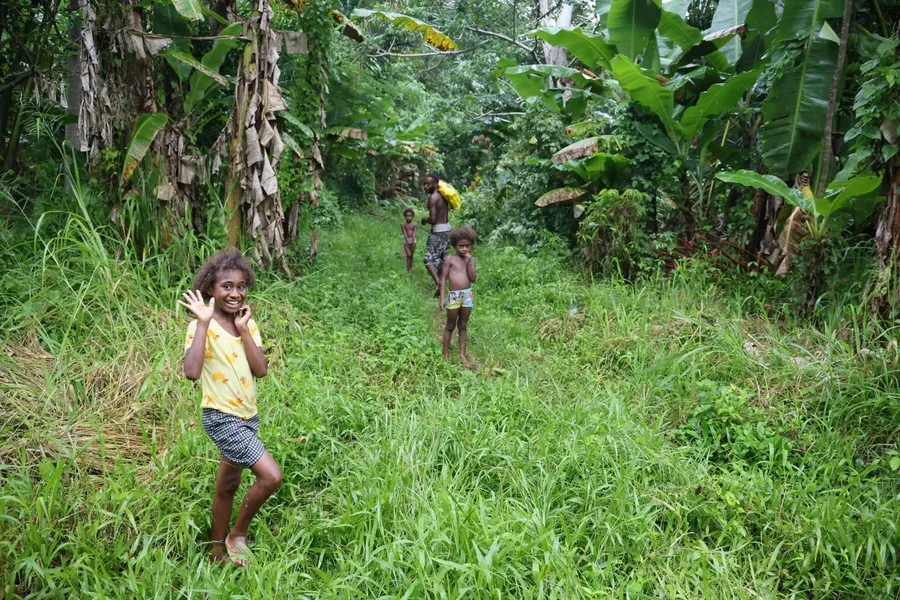
Bislama is the fascinating creole language that brings together Vanuatu's incredibly diverse communities.
It evolved from an English-based pidgin during the 1800s when Melanesian workers were taken to plantations in Australia and Fiji.
Bislama blends English and French vocabulary with indigenous Melanesian grammar structures. It's become the common language that unites over 130 different linguistic groups across the island nation.
How Did Bislama Form?
The story begins during what's known as the "blackbirding era" in the late 19th century. Many Ni-Vanuatu (the people of Vanuatu) were taken to work on plantations in Queensland, Australia and Fiji.
When workers from different islands found themselves together, they faced a challenge; they all spoke various local languages but needed to communicate. They developed a simplified communication system (called a pidgin) using English (and occasionally French) words but keeping their familiar Melanesian grammar.
When these labourers returned home to Vanuatu, they brought this new language with them. It quickly spread throughout the islands and continued to develop into the Bislama you'll hear today.
Bislama Today
What started as a simple pidgin has transformed into a stable creole language. Bislama has even become a native language for some people, particularly in urban areas like Port Vila.
Perhaps most importantly, Bislama serves as a vital bridge language (also known as lingua franca) in a country with over 130 indigenous languages. It's the key that unlocks communication between different communities and helps visitors connect with locals.
Pronunciations in Bislama
The first thing to know about pronunciations in Bislama is that it uses a simplified alphabet based on English letters. The language incorporates sounds from various Melanesian languages, English and French, making it a unique creole with its own pronunciation patterns.
How to Pronounce Consonants in Bislama
Most consonants in Bislama are pronounced similarly to English, but there are some key differences:
- B - pronounced as in English "boy"
- D - pronounced as in English "dog"
- F - pronounced as in English "fish"
- G - always hard, as in English "go", never soft
- H - often dropped or very lightly pronounced
- J - pronounced as "ch" sound, so "jif" (chief) sounds like "cheef"
- K - pronounced as in English "king"
- L - pronounced as in English "love"
- M - pronounced as in English "mother"
- N - pronounced as in English "never"
- P - pronounced as in English "people"
- R - rolled or trilled, more pronounced than English
- S - pronounced both as in English "sun", and "sh", hence why many locals say "Bish-lama".
- T - pronounced as in English "table"
- V - pronounced as in English "village"
- W - pronounced as in English "water"
How to Pronounce Vowels in Bislama
Bislama vowels are generally clearer and more consistent than English vowels:
- A - pronounced as in "father" or "car"
- E - pronounced as in "bed" or "pet"
- I - pronounced as in "machine" or "see"
- O - pronounced as in "for" or "saw"
- U - pronounced as in "food" or "blue"
Unlike English, Bislama vowels maintain their pure sounds and don't typically form diphthongs. Each vowel is pronounced clearly and distinctly.
Word Stress in Bislama
Stress in Bislama is generally placed on the first syllable of most words, which makes it quite different from many other Pacific languages. For example:
- kastom (custom) is pronounced "KAS-tom"
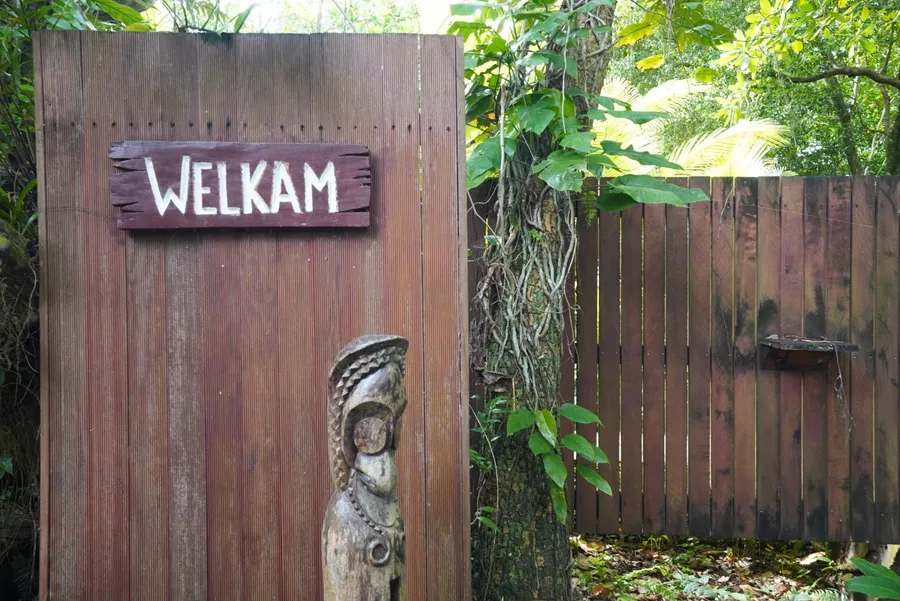
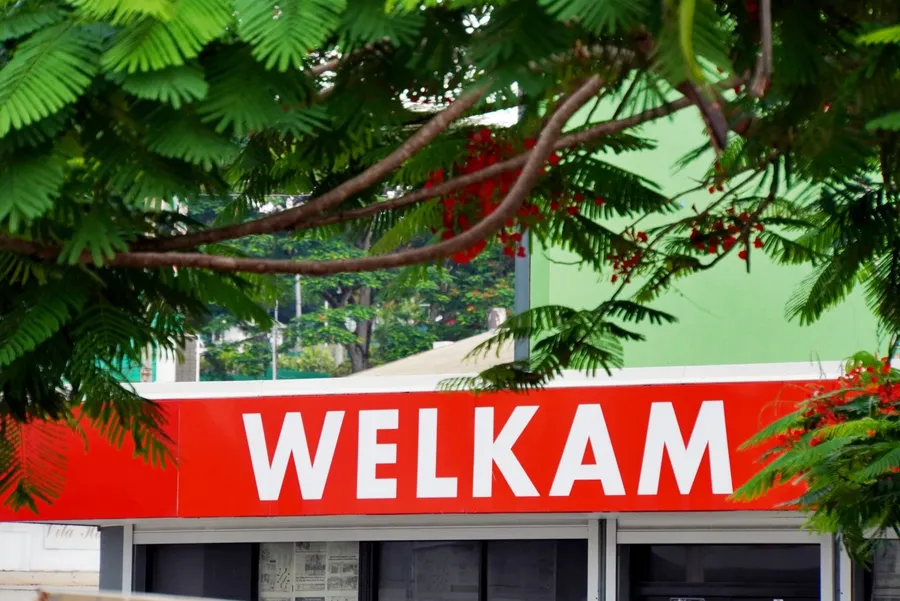
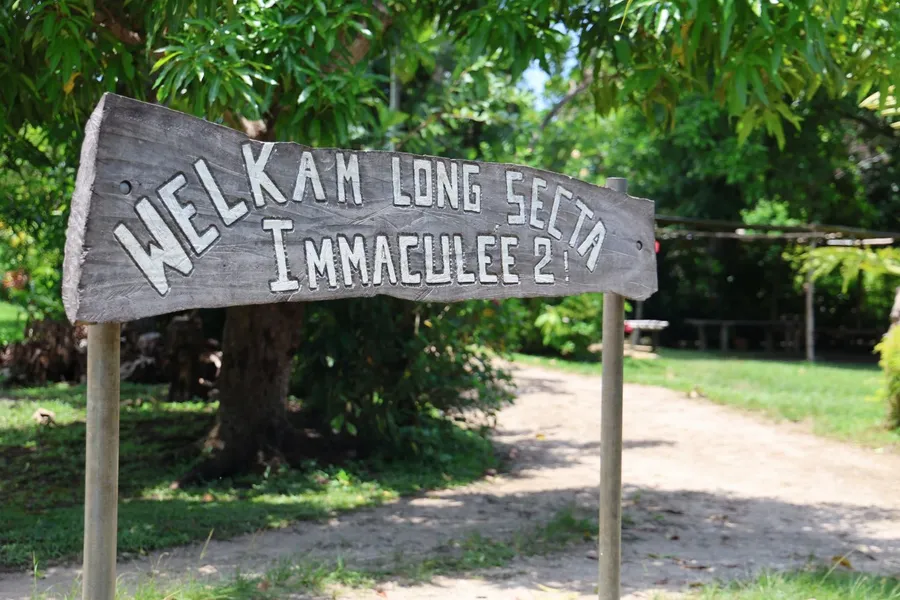
- welkam (welcome) is pronounced "WEL-kam"
- tabu (taboo) is pronounced "TA-bu"
Special Pronunciation Notes
There are several unique aspects to Bislama pronunciation that reflect its creole nature:
Many English words are simplified: "small" becomes smol, "three" becomes tri, and "behind" becomes bihaen.
French-derived words maintain some French pronunciation: merci (thank you) is pronounced with a French accent. (Although the English-derived version, tankyu or tankiyu, is more commonly used).
Some words from local Melanesian languages retain their original pronunciation patterns, which can vary between islands.
The rhythm of Bislama tends to be quite regular, with each syllable given roughly equal time, making it relatively easy for learners to understand once they become familiar with the basic sounds.
Bislama Words and Phrases to Know
Although English and French are spoken in Vanuatu, efforts to speak the national language are very much appreciated. In the outer islands beyond the tourist hotspots of Efate and Santo, locals may not speak English at all - we've experienced this in Malekula, for example - so knowing the Bislama basics will go a long way in the more remote destinations.
What's more, locals living in rural areas and especially the older generation are unlikely to be fluent in English or French (and honestly, maybe not even Bislama if you go way off the beaten track), but knowing a few Bislama words is handy in most instances with locals.
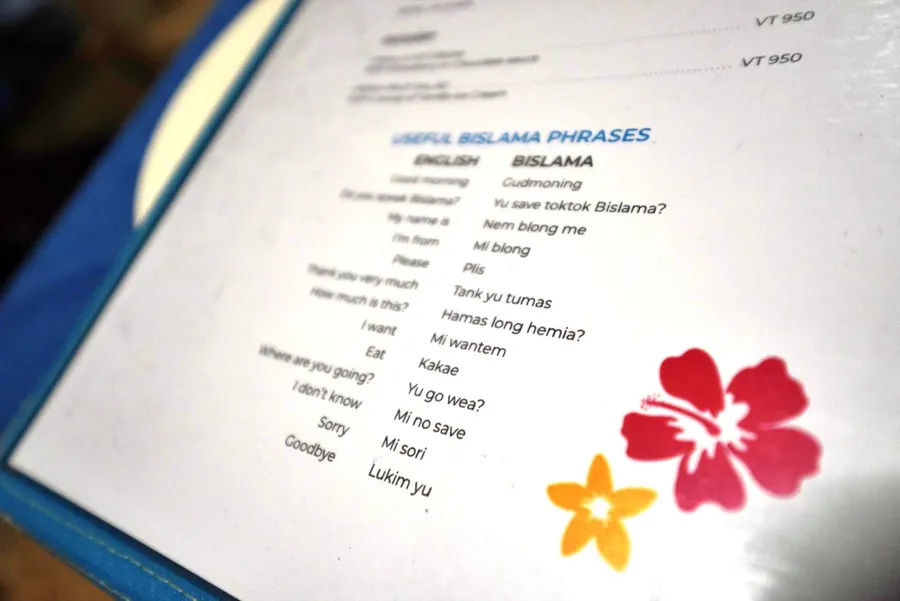
Here are some Bislama words and phrases to try out…
Basic Phrases in Bislama
- Hello – Halo!
- Yes – Yes/Olraet
- No – No
- Please – Plis
- Sorry - Mi sore
- Thank you – Tankyu
- Thank you very much – Tankyu tumas
- Bye – Bae/Ata/Ta
- See you - Lukem yu
- How are you? - Olsem wanem?/Yu oraet?
- I am good, thanks - I gud nomo, tankyu/Mi alraet
- What is your name? - Nem blong yu?
- My name is... - Nem blong mi ...
- How much does it cost? - Wanem nao praes?
- Ok/Right/Correct - Stret!
- It's fine/All good/Ok - Stret nomo!
- Exactly right! - Stret wantaem!
- Awesome!/Excellent!/Number One! - Nambawan!
- Nice meeting you - Naes blong mitem yu
- The food was very nice - Kakai e nice tumas
Places in Bislama
- Beach – Sanbij
- House – Haos
- Church – Joj
- Sea – Solwota
- Reef – Rif
- River - Reva
- Volacano – Volkeno
- Island – Aelan
- Village – Vilij
Food and Drink in Bislama
- Fish – Fis
- Octopus – Nawita
- Meat – Mit
- Chicken – Faol
- Pork – Pig
- Fruit – Frut
- Taro – Taro (tropical root vegetable)
- Breadfruit – Bredfrut
- Water – Wota
- Coffee – Kofi
- Tea – Ti
- Liquor – Dring
- Milk – Milk
- Wine – Waen
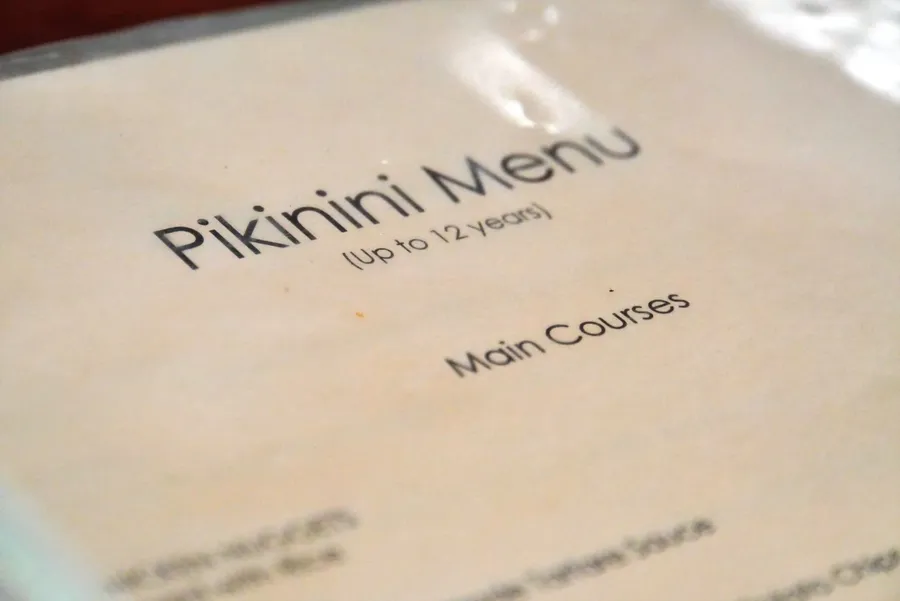
- Child - Pikinini (jokes - people don't eat children in Vanuatu... anymore. But we do love the word pikinini).
Now that you know the important words, check out how to say some iconic Vanuatu meals in the Traditional Vanuatu Food: 10 Foods to Try in Vanuatu.
Do I Need to Speak Bislama to Visit Vanuatu?
The short answer? Not at all! You can absolutely explore Vanuatu without speaking a word of Bislama.
English is widely spoken throughout the tourism industry, so you'll have no trouble communicating at hotels, restaurants, tour operators and attractions. From what we've experienced, most tourism staff speak excellent English and are genuinely eager to help visitors make the most of their stay.
What Languages Are Spoken in Vanuatu?
Bislama is the national language that brings everyone together across Vanuatu's 83 islands.
English comes in as a strong second, especially in tourist areas. While it might not be everyone's first language, we've found that locals in the tourism industry are incredibly skilled at communicating with international visitors.
You'll also hear French spoken around the islands, particularly in areas like Malekula, but French schools still operate across the main centres like Efate and Santo too.
Each island and community also maintains its own traditional language.
Getting By as a Tourist
Tourism operators are well aware that most visitors don't speak Bislama, and they've adapted beautifully to welcome international guests.
That said, learning a few basic Bislama phrases can add a delightful dimension to your travels. Locals absolutely light up when visitors make an effort to use their language, even if it's just a simple "tankyu tumas" (thank you very much).
During our visits, we have met a few bungalow and guesthouse operators in the more remote parts of Vanuatu who are not confident speaking English, preferring to speak Bislama instead. If you don't speak Bislama, speaking slowly in English typically works. But if you're going to the outer islands, learning some Bislama is helpful.
We've found that any small language barriers are quickly overcome by the genuine warmth and patience of Vanuatu's people.
Editor's Choice
Isles of Discovery Vanuatu Tours & Transfers
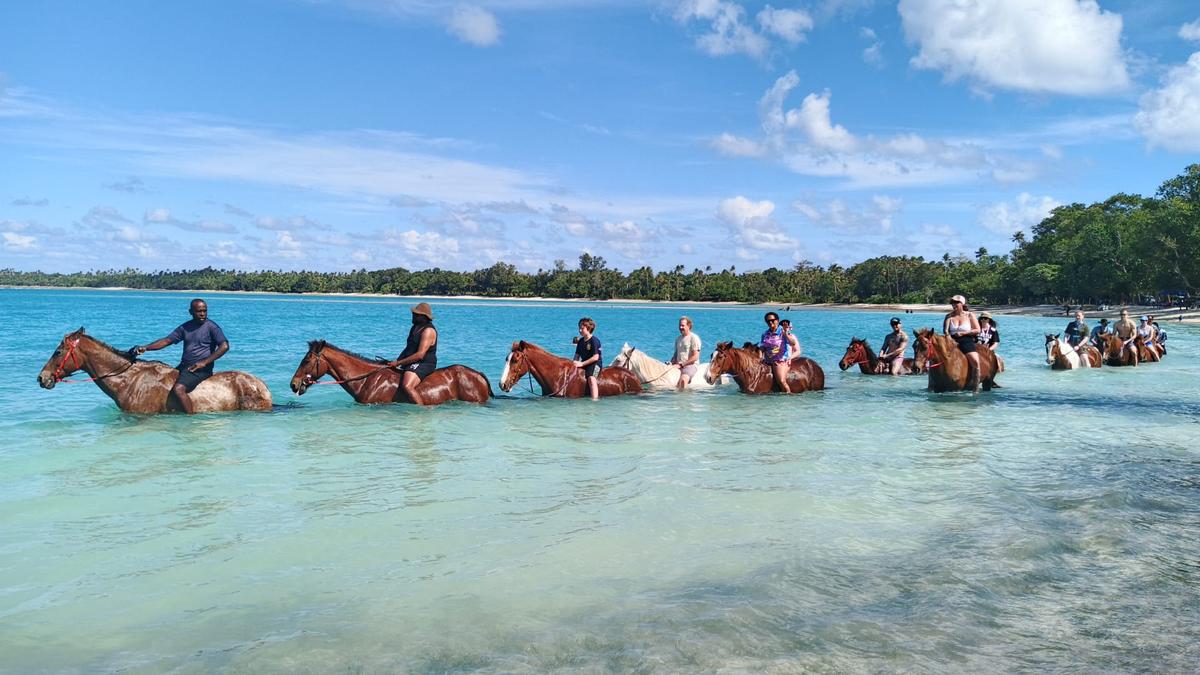
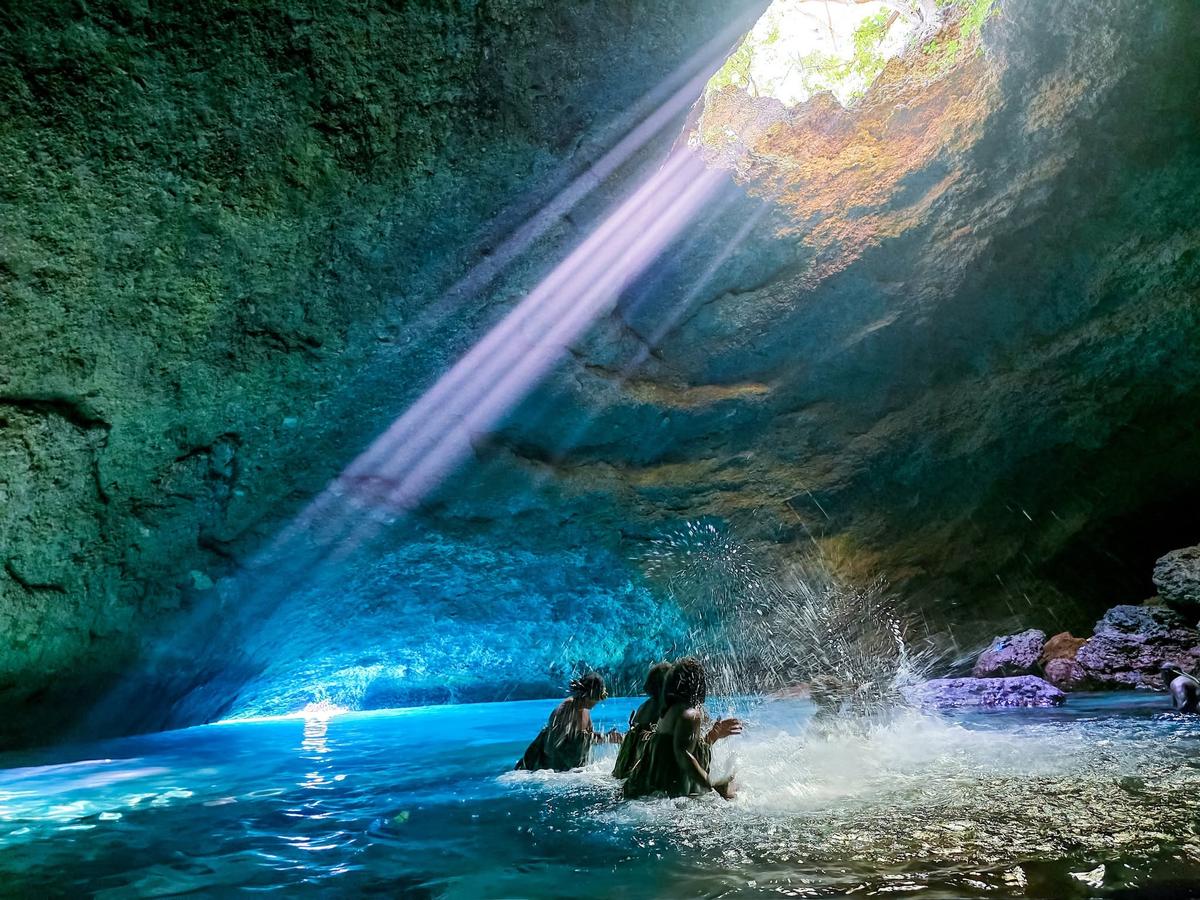
From horseback rides through lush trails and beachfront coconut plantations to swimming in the turquoise waters of Blue Lagoon, this five-hour adventure packs in some of Vanuatu's most memorable...
Frequently Asked Questions About Languages in Vanuatu
Now that you know about the incredible linguistic diversity of Vanuatu, here are the answers to the internet's frequently asked questions about languages in this fascinating South Pacific nation!
How many languages are spoken in Vanuatu?
Vanuatu is home to 138 indigenous languages, making it one of the most linguistically diverse countries in the world per capita. The three official languages are Bislama (a creole), English and French.
What is Bislama and is it widely spoken?
Bislama is Vanuatu's national language and serves as the primary means of communication between different communities within Vanuatu. It's a creole language based on English vocabulary with influences from French and local languages, and virtually everyone in Vanuatu speaks it.
Do people speak English in Vanuatu?
Many do. English is one of the three official languages and is widely understood, especially in tourist areas, hotels and restaurants. However, Bislama remains the most commonly spoken language for daily communication and village visits on the outer islands.
Is French spoken in Vanuatu?
French is an official language due to Vanuatu's colonial history as the New Hebrides under joint British-French administration. It's primarily used in formal settings, some schools and by older generations, though it's less common than English or Bislama, apart from some islands, like Malekula where French is more common than English.
What are some basic Bislama phrases visitors should know?
Essential Bislama phrases include "halo" (hello), "tankyu tumas" (thank you very much), "gud bai" (goodbye), "olsem wanem?" (how are you?) and "wanem nao praes?" (how much does it cost?) Learning a few phrases will delight locals and enhance your travel experience.
Why does Vanuatu have so many indigenous languages?
Vanuatu's mountainous terrain and scattered island geography have historically isolated communities, allowing distinct languages to develop and flourish over centuries. Each island or region often has its own unique language.
For more information, check out A Traveller's Guide to the Ni-Vanuatu Culture.
More About the Culture and Language of Vanuatu
That's it for our quick guide to the language of Vanuatu. For more Vanuatu wisdom, take a look at these similar articles:
- A Traveller's Guide to the Vanuatu Culture
- The Guide to the Religions in Vanuatu
- Vanuatu Etiquette: Vanuatu Customs & Traditions
And if you're planning a trip to Vanuatu, don't miss our Vanuatu Travel Tips: 30 Tips for Travelling in Vanuatu.

%20CREDIT%20VanuatuPocketGuide.com-900x601.webp?v=2026-06-11T01%3A28%3A52.090Z)
-CUNL%20CREDIT%20VanuatuPocketGuide.com-900x600.webp?v=2026-03-08T01%3A22%3A10.914Z)