

Tipping and Taxes for Tourists in Vanuatu
No one wants to hear about the extra fees or taxes they might have to pay anywhere in the world. Luckily, Vanuatu's taxes affecting tourists are limited to four types of tax: Value Added Tax (VAT), Domestic Departure Tax and, for yachties, the clearing out fees.
As the taxes are almost always included in the price, you'll hardly notice that you're paying the extra percentage. What's more, tipping is not customary in Vanuatu, so there's no requirement to factor that into your budget if you don't want to.
Either way, it's always good to be consumer-savvy, so wise up on the taxes that you'll encounter on your trip with this Vanuatu tipping and tax guide for travellers.
For more money advice, see How Much Does a Trip to Vanuatu Cost? and What is the Best Way to Pay in Vanuatu?
This article is based on real on-the-ground research, not on AI scraping old content from the internet. Learn how we use AI!
Table of Contents
Is Tipping Customary in Vanuatu?
It is not customary nor expected for tourists to tip in Vanuatu. Should you want to reward good service, however, a tip will be well received.
In Port Vila, in restaurants and resorts and on tours, tipping is only becoming common because of the influence of tourism, though it is still not a requirement.
In kastom (traditional) terms, it is obligatory for the one receiving the tip to return the favour, so avoid tipping in traditional settings to avoid any awkwardness.
Small gifts from your home country are usually better received than cash. If you receive a gift, it is customary to accept it with gratitude; don't deny the gift.
And with all of the customary behaviours out of the way, there are taxes that directly and indirectly affect your budget during your vacation. More on that in the sections below…
%20CREDIT%20VanuatuPocketGuide.com.webp?v=2026-03-07T22%3A37%3A50.413Z)
Taxes on Goods and Services in Vanuatu
VAT Rate: 15% of the price of all goods and services.
A tax applied to all goods and services in Vanuatu is known as Value Added Tax, or "VAT". This tax will be applied to most things that you buy in Vanuatu, from food in restaurants to vehicle hire to any activities you pay for.
Almost all prices displayed in Vanuatu will include VAT, unless stated otherwise. If you're unsure, it's always best to ask whether the price includes VAT.
Goods and Services Exempt from VAT
Some goods and services in Vanuatu are exempt from VAT, including:
- Financial services
- Education supplied by an approved educational institution
- Donated goods and services sold by non-profit organisations
- Residential rental accommodation
- The sale of a property which has been used for residential rental accommodation for at least 5 years.
Learn more about exempt goods on the Vanuatu Customs & Inland Revenue Department website.
Can You Get VAT Refunded in Vanuatu?
Visitors cannot claim a tax refund on VAT in Vanuatu. You can, however, buy goods that are VAT-free, in other words, duty-free in Port Vila and at the arrivals and departures lounges of Bauerfield International Airport – see The Duty-Free Allowances for Vanuatu for more information.
%20CREDIT%20VanuatuPocketGuide.com-900x601.webp?v=2026-03-07T22%3A47%3A23.589Z)
Vanuatu Airport and Seaport Taxes: International and Domestic Departure Tax
Vanuatu Departure Tax: 2,500 VT for international departures, 200 VT for airport domestic departures, and 100-200 VT for seaport domestic departures
Vanuatu has departure taxes for international and domestic flights: 2,500 VT for international departures from Bauerfield International Airport (VLI) and a separate 200 VT provincial tax for many domestic flights (paid separately at the airport).
For the international departure tax, this is included in your airfare. For the Domestic Departure Tax, it's a little more complicated...
How Does the Domestic Departure Tax Work at Airports in Vanuatu?
For domestic flights, the provincial departure tax of 200 VT is not included in tickets and must be paid prior to departure (after check-in) at Port Vila, Efate (VLI); Luganville, Espiritu Santo (SON); Whitegrass, Tanna (TAH); Siwo, Emae (EAE); Tongoa (TGH); Lamen Bay, Epi (LNB); and Valesdir, Epi (VLS).
The process is straightforward: after checking in for your domestic flight, proceed to the departure tax counter with your boarding pass and valid ID (passport for internationals; driving license, VNPF or National ID for locals). Staff will stamp your boarding pass once payment is made; keep this stamped boarding pass as you'll need to show it before boarding, and you may be sent back if the stamp is missing.
Credit cards are not accepted, so ensure you have cash available.
Several exemptions apply: children under 2 years old, adults over 70, passengers with disabilities or requiring urgent medical evacuation, domestic transit passengers, and airport duty staff. The tax only applies when departing - you won't pay this fee when arriving at your destination.
Note that this departure tax cannot be prepaid through travel agents or with your ticket; payment must be made in person at the airport departure tax counter, which operates for every domestic flight.
Learn more about the domestic flight process in our guide, Domestic Flights in Vanuatu: Your Guide to Interisland Flights.
How Does the Domestic Departure Tax Work at Seaports in Vanuatu?
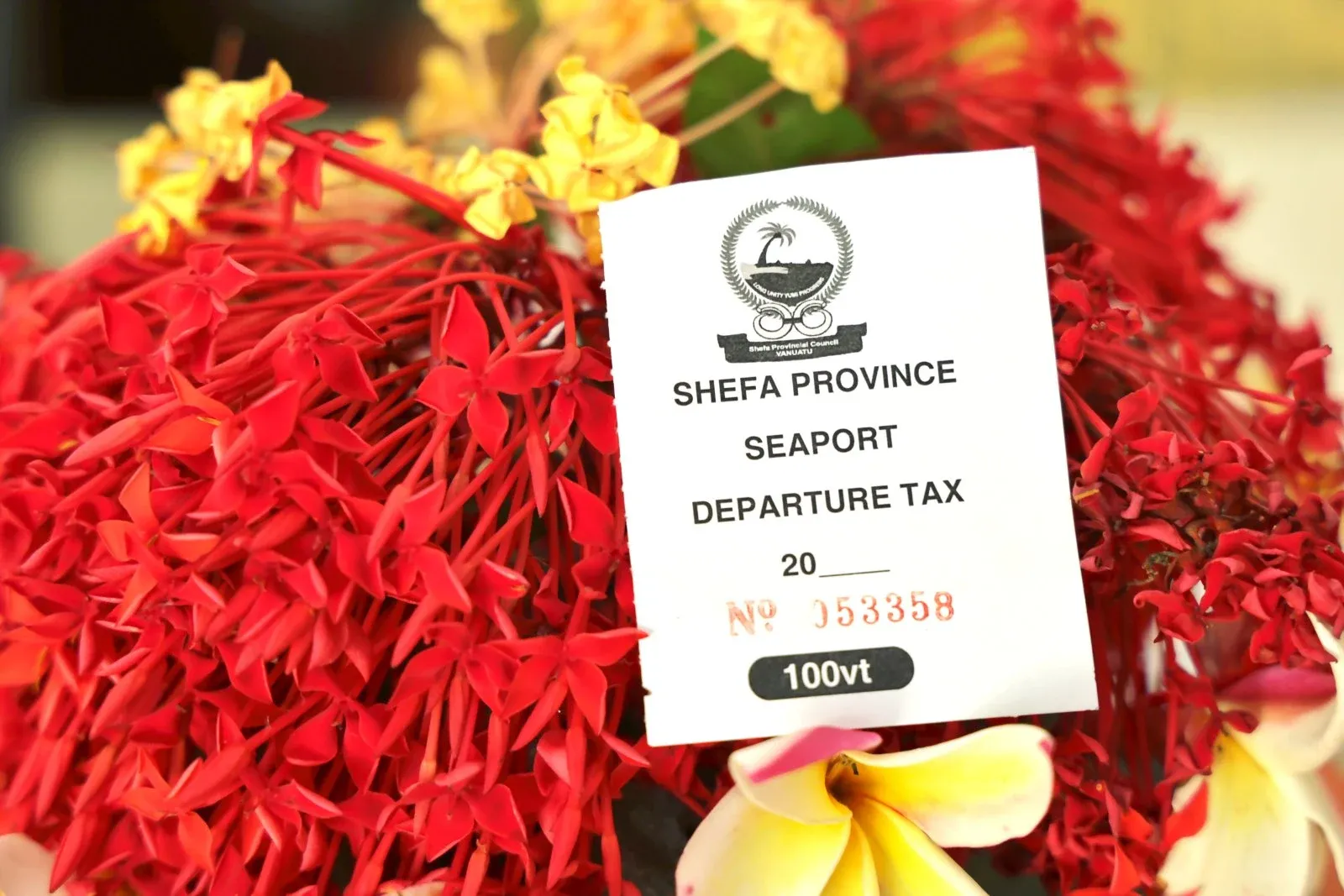
For departing domestically via ferry, the Domestic Departure Tax is 100-200 VT per person.
There is usually a booth or kiosk set up at the ferry wharf taking the fees for the Domestic Departure Tax. Like at the airport (see the section above), payment must be made in cash.
You will receive a receipt/ticket noting that you have paid the departure tax. Show this to the ferry staff when you board the boat.
For more tips for departure, check out Leaving Vanuatu: Departure Tips.

Yacht Clearing Out Fees in Vanuatu: Port Dues and Overtime Fees
Port Dues: 7,000 VT flat fee for up to 30 days, then 100 VT per day after that.
For yachties, when it's time to clear out from Vanuatu, there are a few fees to budget for. The good news? During normal working hours, there are generally no specific Customs or Immigration fees to worry about.
Port Dues
Port Dues are your main expense, and they apply to all visiting small craft. You'll pay 7,000 VT for 30 days (or any part of that period), then 100 VT per day after that. You must pay this fee to the Customs office at your final departure port.
For more information, check out the Vanuatu Customs & Inland Revenue website.
Clearing In or Out at Unofficial Ports
If you're planning to clear out from undeclared ports like Port Resolution instead of the official port at Lenakel, you'll need advance permission (and potentially deep pockets) for the officials' travel costs.
This fee for transport (around 6,000 VT but can vary with fuel prices), which at least gets split amongst all yachts clearing out together, so the more the merrier!
Fees for Overtime
Timing your departure during normal working hours (Monday to Friday, 7:30 am to 12 pm and 1 pm to 4:30 pm) does not incur extra charges. Outside these hours, you'll face overtime fees with a minimum three-hour charge per officer:
- 6 am to 7:30 am and 4:30 pm to 6 pm (Monday to Friday): 1,000 VT per hour per officer
- 6 pm to 6 am (Monday to Friday): 1,500 VT per hour per officer
- Weekends and public holidays: 2,000 VT per hour per officer
More information on these fees, again, can be found on the Customs and Inland Revenue website.
If you need to tie up at a government wharf for fuel or supplies, expect wharfage fees based on your vessel's length. You can also arrange duty-free fuel and goods before clearing out, though Customs will seal everything until you actually leave Vanuatu.
For comprehensive guidance on sailing in these waters, we recommend checking out our Sailing Guide to Vanuatu.

Editor's Choice
Chief Roimata Domain Tour
Travel back more than 400 years and discover the story of one of Vanuatu’s most legendary chiefs. The Chief Roi Mata Domain Tour explores sacred sites across Efate and nearby islands, following...
More About Tipping, Taxes and Money in Vanuatu
That's it for our guide to tipping in Vanuatu, as well as taxes in Vanuatu for travellers. For more about money and budget in Vanuatu, check out the following guides:
- What is the Best Way to Pay in Vanuatu?
- Vanuatu Travel Budget: How Much Does a Trip to Vanuatu Cost?
- The Best Places to Exchange Money in Vanuatu
Finally, for more essential tips, head to the 30 Tips for Travelling in Vanuatu.

%20CREDIT%20VanuatuPocketGuide.com-900x601.webp?v=2026-06-11T01%3A28%3A52.090Z)
-CUNL%20CREDIT%20VanuatuPocketGuide.com-900x600.webp?v=2026-03-08T01%3A22%3A10.914Z)